

In many plants, pneumatic valves get treated like a commodity. If the valve fits the manifold and meets the cost target, it goes in.
That approach breaks down when valve behaviour becomes a reliability variable.
When a valve starts sticking, leaking internally, or drifting in response, the impact is usually indirect:
- intermittent faults that consume troubleshooting time
- inconsistent actuator motion that affects repeatability
- increased air consumption from internal leakage
- higher maintenance touch time and more disruptive interventions
From an engineering standpoint, these symptoms are often linked to the sealing approach and friction behaviour at the spool and bore interface.
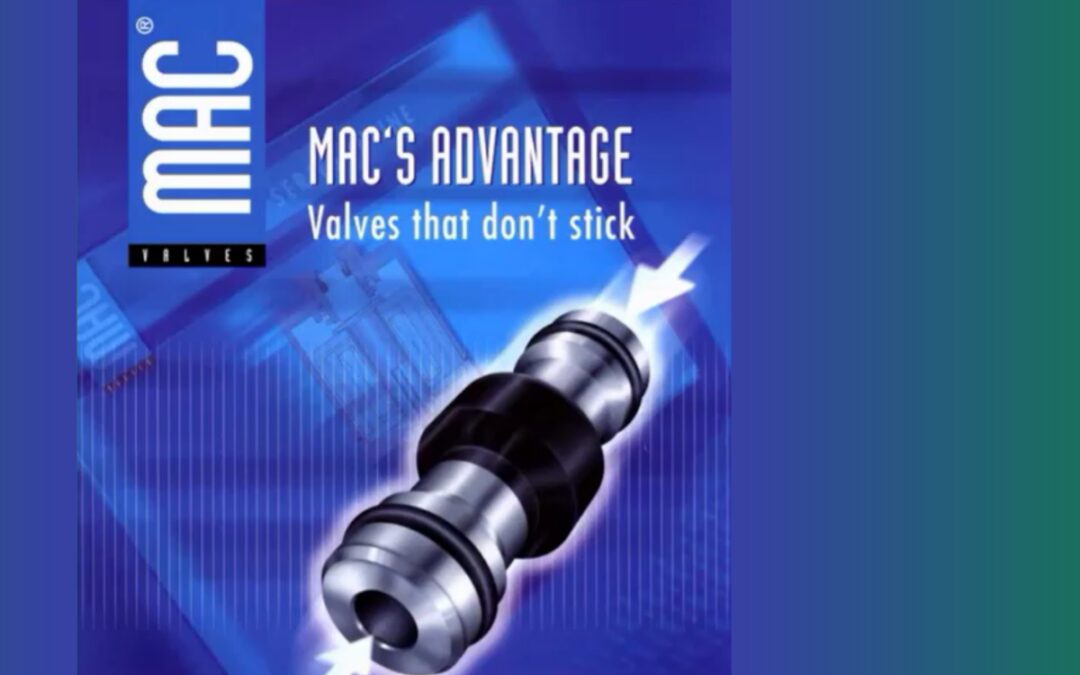
The MAC D-seal design features
MAC describes the D-seal, bonded spool, and finished bore as design features intended to improve shift consistency and tolerance to contamination in pneumatic spool valves.
In practical terms, the published design intent focuses on:
- a bonded spool and a controlled spool-to-bore interface
- a wiping action intended to move contamination rather than trap it
- stable shifting forces intended to support repeatable valve response over high cycle counts
Why dynamic behaviour matters
Datasheet comparisons often focus on port size and flow coefficients. In production duty, dynamic behaviour is usually what drives faults and rejects.
The questions that matter on a line are typically:
- does the valve shift cleanly and repeatably through sustained cycling?
- does response remain consistent across start-up conditions and ambient changes?
- does the valve tolerate real plant air quality, including inevitable variability?
Different spool valve designs use different sealing and friction strategies. In high-cycle or marginal air-quality conditions, some designs can become more sensitive to friction rise and contamination effects. When repeatability degrades, the issue presents as timing drift, intermittent faults, or nuisance stops.
Where MAC D-seal valves are often specified
Based on the application types MAC targets in their literature, D-seal valves are commonly selected for duties such as:
- high-cycle motion (pick-and-place, indexing, diverters, fast actuators)
- tight timing windows where response drift drives rejects
- reliability-critical functions where nuisance trips are unacceptable
- installations where air quality variability is a known constraint even with filtration
- hard-to-access manifolds where intervention cost and disruption are high
What “better” means in measurable terms
If a valve is performing well in a given application, it typically shows up as:
- fewer sticking-related events and fewer intermittent faults
- more repeatable motion on fast sequences
- lower maintenance intervention rates on the valve bank
- more stable air consumption by reducing leakage-driven waste
- Improved uptime by removing a common weak point
These outcomes are consistent with what manufacturers generally aim to achieve when they design for friction stability, contamination handling, and repeatable spool movement.
How to evaluate objectively on your site
A straightforward way to validate selection is to run a controlled comparison:
- baseline nuisance faults, timing variability, rejects, and maintenance touch time on a problem axis for 4–6 weeks
- change only the valve bank on that axis to the alternative valve selection
- keep actuators, FRLs, controls, and logic unchanged
- measure the same KPIs over the same production conditions
This approach keeps the comparison evidence-based and reduces debate about subjective “feel”.
For high-cycle and repeatability-driven duties, MAC’s D-seal design features are positioned as an engineering-led approach to improving valve consistency under real plant conditions.