

Even the smallest deviation in measurement can impact product quality, compliance, and operational efficiency.
That’s why on-site calibration of temperature sensors has become a critical service for modern industry. By bringing traceable calibration standards directly to your facility, technicians can verify and fine-tune accuracy within the sensor’s actual operating environment, ensuring your entire measurement loop performs as intended.
This approach ensures confidence in every reading from the sensor itself through to the transmitter and PLC, validating the system as a complete, integrated measurement chain.
Why Field Calibration is the Smarter Choice:
Traditional laboratory calibration has its place, but field calibration offers a range of practical advantages that better suit modern industrial environments:
- Minimised Downtime – Instruments remain installed during calibration, significantly reducing downtime from days to just minutes or hours. This is especially valuable in continuous production environments where shutdowns are costly.
- Real-World Operating Conditions – Field calibration accounts for real environmental influences such as vibration, electrical noise, and installation stress — factors that cannot be fully replicated in a laboratory setting.
- Full Loop Verification – Technicians can calibrate and verify the entire measurement loop, ensuring the sensor, wiring, transmitter and control system all communicate accurately and reliably.
- On-the-Spot Documentation – Using portable calibrators and software, calibration certificates can often be issued immediately, helping maintain compliance records without delay.
- Ideal for Fixed or Large Systems – Field calibration is particularly effective for systems where removal is impractical, such as food and beverage production lines or continuous process plants.
On-Site Pt100 Calibration: Standard Operating Procedure (SOP)
The following SOP outlines how a Pt100 RTD sensor is calibrated in the field using a portable dry-block calibrator.
Preparation and Safety
Before calibration begins, proper preparation ensures both safety and accuracy:
- Isolate the sensor from the process. If installed in a thermowell, the probe may often be removed without depressurising the system.
- Perform a visual inspection to identify any mechanical damage, corrosion, or moisture ingress.
- Set up the dry-block calibrator on a stable, level surface away from drafts and connect it to a suitable power source.
Sensor Setup
Correct setup is essential for achieving accurate results:
- Select the correct insert ensuring a snug fit (typically ~0.5 mm clearance) for optimal thermal transfer.
- Ensure proper immersion depth, placing both the Pt100 sensor (Unit Under Test) and reference probe fully into the block to minimise stem conduction errors.
- Monitor resistance or temperature readings using a traceable meter or local HMI interface.
Calibration Procedure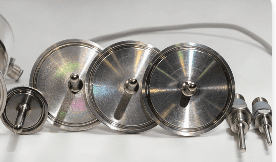
- The calibration process is carried out systematically across defined test points:
- Define Test Points – Select at least three points across the operational range (for example, 0%, 50%, and 100%).
- Ramp and Stabilise- Set the calibrator to the first test temperature and allow the system to stabilise. Thermal equilibrium typically takes 10–30 minutes depending on the temperature change.
- Record Measurements- Once stable, record:
– The reference temperature from the dry-block or calibrated reference device
– The output reading from the Pt100 sensor - Repeat Process- Repeat the same steps for each remaining test point to build a complete calibration profile.
Documentation
Accurate documentation is a key part of compliance and traceability:
- A full calibration report is generated upon completion
- Certificates are issued for compliance and audit purposes
- Clients are provided with secure access to cloud-based calibration records for future reference
Why choose BONNER?
Beyond calibration itself, experienced field technicians provide added value by identifying and resolving complex instrumentation issues such as:
- Signal noise and interference
- Grounding and loop faults
- Installation or wiring inconsistencies
This combination of calibration expertise and system diagnostics ensures not only accurate measurement but also improved overall system performance.
Book Your Temperature Sensor Calibration:
Accurate temperature measurement is essential for safe, efficient, and compliant operations.
Partner with BONNER to ensure your thermal processes remain precise and reliable with professional on-site calibration services.