

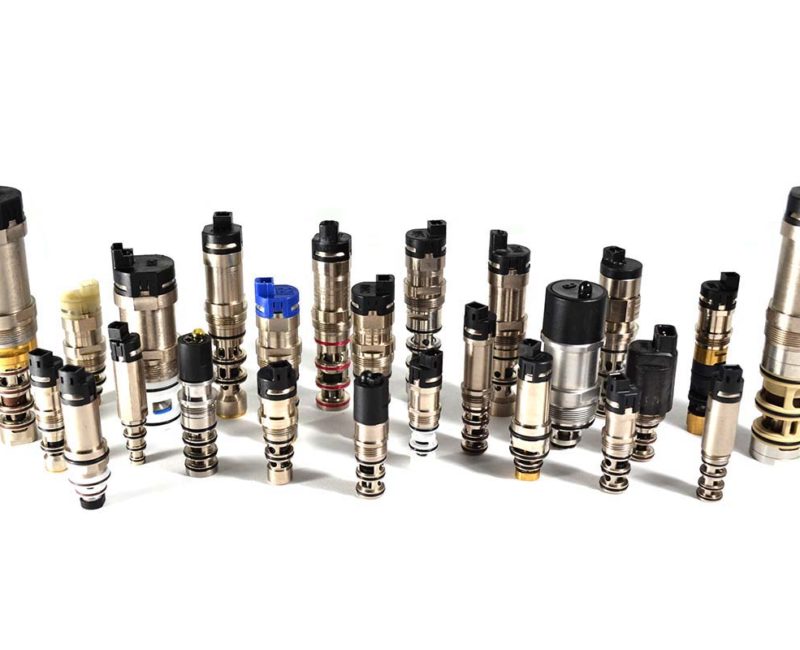
MAC valves from BONNER
1. OEM design and performance drivers
Across most OEM sectors, including packaging, life sciences, food, medical devices, and general automation, machines are expected to deliver consistent mechanical performance over long operational lifetimes. While pneumatic systems are often viewed as mature technology, valve selection remains a critical determinant of how reliably a machine performs in practice.
The core performance drivers are consistent across sectors:
-
- High cycle rates with repeatable motion over long service life
- Stable behaviour across pressure variation and changing duty profiles
- Predictable response under contamination, wear, or marginal air quality
- Minimal unplanned downtime and reduced service intervention
- Simplified spares strategies and long-term global supportability
- Differentiation based on machine reliability rather than lowest component cost
Pneumatic valves sit directly at the interface between control intent and mechanical motion. Their internal design governs how force is applied, how consistently motion is executed, and how that behaviour evolves over time. Treating valves as interchangeable commodities overlooks their influence on system stability and lifecycle performance.
2. MAC core technical differentiators
2.1 Balanced spool design and D-seal technology
MAC valves use a force-balanced spool combined with a floating D-seal arrangement, rather than elastomeric O-rings sliding in the valve bore.
From an internal design perspective, this architecture results in:
-
- Very low friction during spool movement
- Minimal dependence on lubrication films
- No radial seal compression against the bore during switching
- Stable sealing geometry independent of pressure direction
Because the spool is balanced, changes in supply pressure, exhaust pressure, or downstream load have limited influence on the force required to shift the valve. The D-seal floats rather than drags, maintaining sealing without introducing significant friction.
In contrast, conventional O-ring based spool designs are inherently influenced by:
-
- Seal compression and deformation
- Lubrication condition
- Temperature-dependent elastomer behaviour
- Wear-induced friction increase
- Small particulate contamination embedded in the seal
The practical consequence for OEM machines is that MAC valve behaviour remains consistent over time, rather than gradually changing as seals wear or conditions vary. Motion profiles defined during design and commissioning remain representative of in-service behaviour, not just factory acceptance conditions.
2.2 Switching consistency and repeatability
MAC valves are engineered to shift fully and decisively between states, even under reduced pilot pressure or dynamic load conditions.
From a system behaviour standpoint, this provides:
-
- Clear and repeatable end states
- Stable internal flow paths once shifted
- Reduced sensitivity to marginal operating conditions
At machine level, this results in:
-
- Consistent cylinder end positions
- Reduced dependency on fine flow-control tuning
- Less drift in timing-critical sequences over time
- Improved repeatability in high-speed or synchronised pneumatic motion
This characteristic is particularly relevant in applications such as:
-
- High-speed packaging and assembly
- Multi-axis pneumatic sequencing
- Clamping, cutting, or forming operations
- Processes sensitive to force or timing variation
Where motion repeatability matters, the valve’s ability to switch cleanly and consistently becomes a defining system characteristic.
2.3 Contamination tolerance and air quality robustness
Compressed air quality varies significantly between installations, even where standards are specified. Moisture carryover, fine particulates, and oil-free operation are common real-world conditions.
The floating D-seal architecture used in MAC valves is inherently more tolerant of:
-
- Moisture in the air supply
- Fine particulate contamination
- Oil-free or lightly lubricated systems
This tolerance does not eliminate the need for proper air preparation, but it reduces the sensitivity of valve behaviour to deviations from ideal conditions.
From an engineering perspective, this means valve performance is governed primarily by design geometry rather than by the condition of elastomeric seals. Once a machine leaves the OEM’s controlled environment, its pneumatic performance remains more predictable across different sites and operating practices.
3. Reliability, uptime, and lifecycle impact
3.1 Mean time between failure and service life
MAC valves are commonly applied in systems characterised by:
-
- Very high cycle counts
- Continuous or near-continuous duty
- Limited tolerance for unplanned stoppages
Their internal design minimises friction and wear mechanisms that typically limit valve life in conventional designs.
For OEM machines, the resulting behaviour is:
-
- Extended service intervals
- Reduced frequency of valve-related failures
- Lower spare valve consumption over the machine lifecycle
These factors directly influence the total cost of ownership experienced by the end user, which increasingly feeds back into OEM evaluation and repeat business.
3.2 Predictable degradation behaviour
All mechanical components degrade with time. The engineering concern is not whether degradation occurs, but how it manifests.
MAC valve performance typically degrades gradually rather than abruptly. Changes in leakage or response tend to be incremental and observable, rather than sudden failures.
This supports:
-
- Condition-based maintenance approaches
- Planned component replacement during scheduled downtime
- Reduced likelihood of sudden loss of function
From a system design standpoint, predictable degradation is preferable because it allows maintenance activity to be planned and controlled, rather than reactive.
4. OEM engineering efficiency and standardisation
4.1 Reduced application-specific variation
MAC valve families are designed around a small number of consistent internal architectures, scaled across sizes and flow ranges.
This enables OEMs to cover a wide range of machine functions using:
-
- Fewer valve platforms
- Common spares across machine variants
- Consistent behaviour across different applications
For OEMs with multiple machine sizes, global deployments, or long product lifecycles, this consistency reduces design complexity and simplifies long-term support.
4.2 Faster commissioning and reduced tuning effort
When valve behaviour is stable across pressure, load, and duty changes, less compensation is required elsewhere in the system.
In practice this results in:
-
- Reduced time spent tuning flow controls
- Stable motion profiles after shipment
- Less rework during site commissioning
At organisational level, this translates into:
-
- Fewer engineering hours per machine
- More predictable commissioning schedules
- Reduced risk on fixed-price or time-critical projects
5. Commercial and strategic implications for OEMs
5.1 Reliability as a differentiator
As machine platforms converge technically, differentiation increasingly depends on how reliably machines perform over time.
Valve selection influences:
-
- Uptime
- Maintenance burden
- Consistency of operation across sites
Specifying components that support predictable, repeatable performance enables OEMs to differentiate on engineering quality rather than feature count or initial price.
5.2 Lifecycle cost perspective
While MAC valves may not represent the lowest unit purchase cost, the dominant cost drivers in pneumatic systems are:
-
- Downtime
- Maintenance labour
- Spare parts logistics
- Production disruption
From a lifecycle perspective, component price is secondary to behaviour in service. Senior decision-makers typically recognise that a single unplanned stoppage outweighs the cost difference between valve technologies.
5.3 Long-term supply continuity
MAC has historically maintained:
-
- Long product lifecycles
- Backward compatibility within valve families
- Support for legacy platforms
For OEMs, this reduces the risk of forced redesigns and supports long-term spares strategies, particularly for machines with extended operational lifetimes.
6. Positioning versus conventional alternatives
This assessment does not dismiss other suppliers, many of whom provide high-quality general-purpose pneumatic components.
The distinction lies in design intent:
-
- Broad catalogue suppliers optimise for coverage and flexibility
- MAC optimises for repeatability, endurance, and predictable behaviour
For OEMs building high-duty, mission-critical, or performance-sensitive machines, this design focus aligns closely with long-term system requirements.